


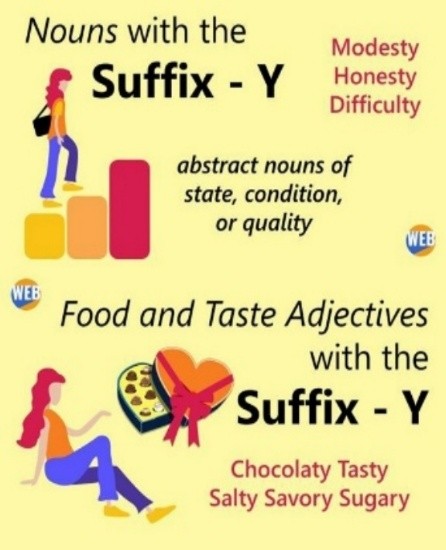
 Have you ever thought about why Y is such an important letter in the English language? Aside from having four different sounds (yellow, cymbal, happy, cry), it is a suffix that we use all the time. The suffix -y is a small but powerful ending in English, used to transform words and add layers of meaning, tone, and description. Often attached to nouns or verbs, -y typically forms adjectives, signaling that something has the qualities of, is characterized by, or is full of whatever the base word names. Because of this flexibility, -y plays a major role in making English expressive and vivid.
 One of the most common functions of -y is to describe physical qualities. When added to nouns, it helps convey texture, appearance, or condition. Words like muddy, hairy, greasy, fruity and watery instantly create sensory images. Rather than stating that something has mud or water, the suffix compresses meaning into a single, efficient adjective. This makes descriptions more natural and conversational.
The suffix -y also expresses emotional or behavioral traits. Words such as moody, sleepy, bossy, or cheery describe tendencies or states of mind, often in a casual or informal tone. Because of this, -y frequently appears in everyday speech and creative writing. It can soften descriptions or make them feel more personal, especially when describing people, moods, or habits.
 In addition, -y is used to form adjectives that suggest abundance or frequency. Terms like rainy, snowy, or noisy imply that something is filled with or dominated by a certain quality. This usage is especially common in weather descriptions and environmental contexts, where concise imagery is useful.
Finally, -y sometimes adds a playful or diminutive tone, as seen in words like kitty, doggy, or mommy. In these cases, the suffix contributes emotional warmth rather than factual detail.
With all the words that can take the suffix -y, you can turn simple words into descriptive adjectives or affectionate words, enriching and expanding your vocabulary making communication clearer and more vivid. Erik